Scientists Confirm Extraterrestrial Origin of Metal in Tutankhamun's Famous Dagger
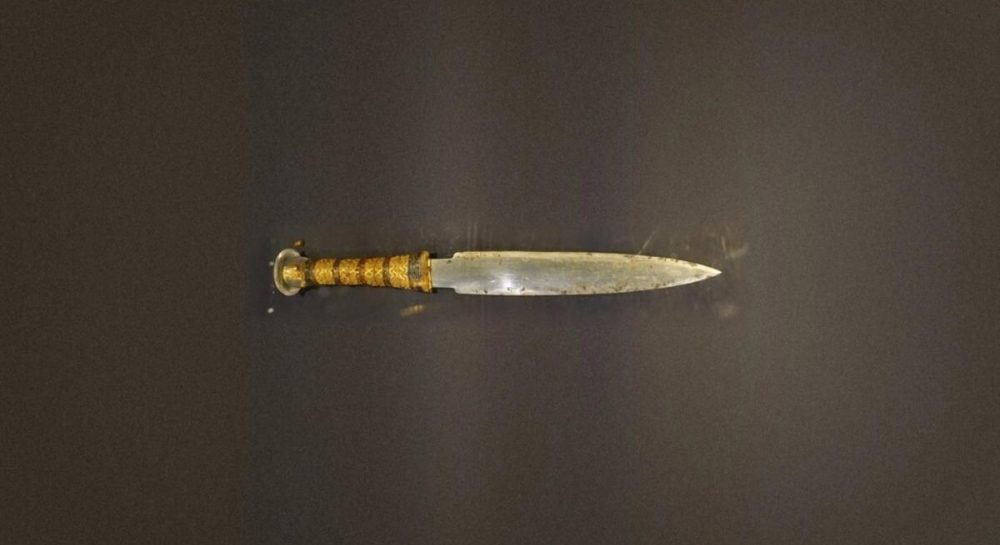
Studies of the material of the legendary dagger from the tomb of Pharaoh Tutankhamun have conclusively proven it was made from iron of meteoritic origin. However, the exact source of the cosmic body's impact remains undetermined.
 🎭Culture & Sport
Photo: UNIAN
Key points
- Tutankhamun's dagger made from meteoritic iron
- Nickel and cobalt content confirms extraterrestrial origin
- Metal was forged at temperatures up to 950 °C
Discussions continue regarding the results of long-term scientific analysis of artifacts from the tomb of Pharaoh Tutankhamun. Researchers have focused considerable attention on a unique iron dagger discovered during excavations in 1925 among the ruler's burial wrappings. Recent technological research has made it possible to determine the chemical composition of the blade with high precision and confirm its meteoritic origin.
Chemical Composition and Ancient Craftsmanship
Key laboratory analyses of the metal's composition were conducted in stages, notably in 2016 and 2022. Using portable X-ray fluorescence analysis, researchers examined the blade and found exceptionally high concentrations of nickel (about 10.8%) and cobalt (about 0.58%). In conventional historical iron of terrestrial origin, the nickel share rarely exceeded 4%, whereas such figures are typical for iron meteorites. This served as convincing chemical evidence of the material's cosmic origin.
Analysis of the artifact's crystal structure also demonstrated that ancient metalsmiths possessed a high level of skill. The metal was subjected to heating in the range of 700 °C to 950 °C followed by forging. In the 14th century BC, during the Late Bronze Age, iron smelting from ore was not yet widespread in the Nile Valley, making the use of meteoritic material an exceptional value even for a pharaoh.
The Mystery of the Cosmic Material's Origin
Despite the clearly established chemical composition and evidence of forging, the exact impact site of the meteorite used to forge the weapon remains unknown. Similar proportions of elements are found in many meteorites, and the processing altered the original structure. Scientists note that neither the exact location where the raw material was found nor the trade routes by which it reached Ancient Egypt can be identified with absolute certainty.
Source UNIAN — unian.ua/science/kindzhal-tutanhamona-vcheni-doveli-yogo-pozazemne-… ↗
Read next
 🛡️Security
Energy workers restore power in Rivne region following enemy attack
Power supply has been fully restored in the Sarny district of the Rivne region after being disrupted by a Russian attack on November 20.
 👥Society
Autumn Rose Care: Expert Advice for Drohobych Gardeners
Experts explain why gardeners should avoid radical pruning of roses until persistent frosts set in.
 🛡️Security
Rescue operation in Dymer: 89-year-old woman pulled from the rubble
Search operations continue in the village of Dymer, Kyiv region, following a drone strike on a residential building. The death toll has risen to nine.
 🛡️Security
Russian corvette 'Merkury' in Libya: Likely hit by Ukrainian drones
An explosion occurred on a Russian warship in the Libyan port of Benghazi, which, according to Associated Press, may have been the result of a Ukrainian maritime drone at…
 🏛️Politics
Russia tests NATO defense algorithms through airspace violations, says Dmytro Kashchenko
Russian provocations involving missiles and drones over NATO territory are aimed at testing the Alliance's readiness and response mechanisms.
 🏙️City
Global Warming and the 'Awakening' of Ancient Bacteria: New Research Findings
Researchers from the University of Colorado discovered that bacteria frozen in permafrost for 40,000 years can regain activity when temperatures rise.